
Remote Patient Monitoring (RPM) has crossed a major operational tipping point.
With U.S. remote care investments on track to exceed $29 billion, outpatient practice leaders and Chief Medical Officers are no longer asking whether to implement RPM—they are asking why their current vendor software produces so much data overload and so little clinical return.
The fundamental challenge facing practice leaders in 2026 is simple: alert fatigue.
Legacy RPM software platforms function like passive pipelines.
They collect daily blood pressure or glucose readings and flood clinic portals with red flags, leaving already overworked nursing staff to figure out what actually went wrong.
As the Centers for Medicare & Medicaid Services (CMS) tightens audit standards and expands code tiers under the CMS Medicare Physician Fee Schedule, selecting the right RPM partner is a high-stakes clinical and financial decision.
The Missing Link: Why Software Alone Fails
To understand why passive software tools consistently fall short, consider how an abnormal biometric alert plays out in a typical outpatient practice.
In a traditional passive RPM setup, when a patient’s blood pressure surges over a seven-day stretch, a generic dashboard alert is generated.
A triage nurse sees the spike, calls the patient to ask if she feels unwell, and sends a chart message to the physician suggesting a higher medication dose.
This standard approach creates three major points of friction:
-
Staff Overburden: Nurses become administrative triage clerks instead of focusing on bedside care.
-
Unresolved Root Causes: A simple device alert cannot identify why a vital sign spiked—whether due to poor adherence, an over-the-counter drug conflict, or improper technique.
-
Audit Liability: Billing monthly management codes without documented clinical intervention by qualified healthcare professionals exposes the practice to MAC audit clawbacks.
2026 Vendor Evaluation Criteria: What Practice Leaders Must Demand
When auditing RPM software and service partners this year, healthcare executives should evaluate candidates against four non-negotiable standards:
-
Active Clinical Resolution: Does the vendor employ licensed clinicians (such as board-certified pharmacists) to actively reconcile medications and resolve alerts, or do they dump raw data back onto your clinic staff?
-
Audit-Proof CMS Compliance: Does the platform generate time-stamped, clinician-verified audit trails that satisfy Medicare Administrative Contractors (MACs) and the HHS Office of Inspector General (OIG)?
-
2026 Code Tier Alignment: Is the vendor equipped to handle CMS code additions, such as short-threshold data transmission (CPT 99445, 2–15 days) and lower-tier care management time (CPT 99470, 10–19 mins)?
-
Native EHR Integration: Does the platform write clinical notes, time logs, and consent records directly into your native EHR, or does it force your team to manage a separate third-party portal?
The Pharmacist-In-The-Loop Advantage
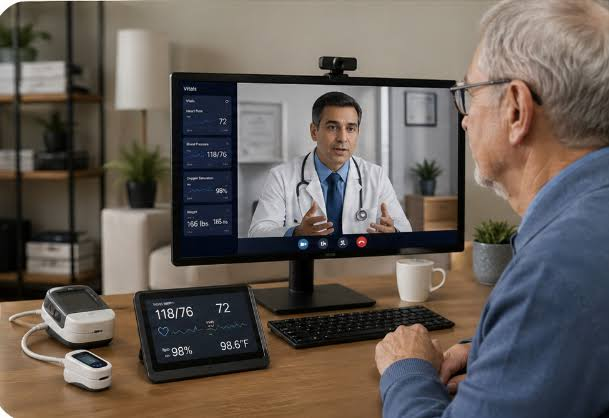
Under a pharmacist-led virtual care model, the operational workflow resolves the underlying clinical problem immediately, rather than just reporting a number:

Board-certified pharmacist resolving clinical alerts and reviewing medications. Source: Rockaa / Getty Images
For instance, Mrs. S.*, a 72-year-old patient managing hypertension, had maintained stable blood pressure readings for weeks before her systolic pressure suddenly spiked over a seven-day stretch.
Rather than simply flagging the alert, a PharmD Live® Pharmacist Care Manager (PCM) cross-referenced her incoming Remote Patient Monitoring (RPM) telemetry against her complete active prescription record and recent pharmacy fill data.
The PCM uncovered the root cause:
Mrs. S.* had started taking a high-dose over-the-counter NSAID for knee pain, which was blunting the effectiveness of her prescribed antihypertensive medication.
Within 24 hours, the PCM coordinated with her primary care physician, discontinued the problematic OTC drug, and adjusted her pain management plan—averting a potential emergency room visit before the clinic opened on Monday morning.
*Patient details and names have been anonymized to protect privacy in compliance with HIPAA guidelines.
Instead of showing raw numbers, a pharmacist-led care team identifies the underlying cause and handles the clinical resolution before the patient deteriorates.
Top 10 RPM Vendors Comparison 2026
The matrix below evaluates the top Remote Patient Monitoring (RPM) vendors in 2026 across clinical depth, audit readiness, and target audience profiles:
| Vendor | Core Model & Differentiators | Clinical Depth & Oversight | Compliance & Audit Readiness | Ideal Target Audience |
|---|---|---|---|---|
| PharmD Live® | Pharmacist-led + AI-powered. Combines real-time pharmacovigilance, native EHR write-backs, and turnkey care management. | Highest. Board-certified pharmacists manage 100% of patient onboarding, medication reconciliation, and alert triage. | Audit-Proof. Automated time stamps, HIPAA encryption, and complete MAC/OIG audit trails. | Outpatient practices, ACOs, and health systems seeking turnkey clinical growth and zero audit risk. |
| Health Recovery Solutions (HRS) | Full-suite telehealth and RPM platform supporting a wide array of cellular and Bluetooth devices. | Moderate. Strong patient engagement tools, but relies on client nursing staff to manage alerts. | High. HITRUST certified, HIPAA compliant, and provides structured billing logs. | Health systems and home health agencies with existing internal monitoring teams. |
| Optimize Health | Customizable self-service RPM software integrated with Chronic Care Management (CCM) tools. | Self-Service. Software tools designed for in-house clinic teams; no dedicated external staffing. | Moderate. Includes automated time tracking and billing alignment features. | Multi-specialty groups wanting to manage remote monitoring entirely in-house. |
| HealthSnap | Guideline-driven virtual care platform featuring integrated on-ground clinician teams. | High. Employs dedicated nursing staff for chronic care monitoring and outreach. | High. Scalable clinical workflows aligned with standard CMS care management rules. | Health systems and physician groups needing external nursing support. |
| Prevounce | Preventive health platform combining RPM, CCM, and annual wellness visit (AWV) automation. | Moderate. Focused on preventive risk stratification and patient self-management tools. | High. Strong focus on preventive compliance and automated tracking logs. | Value-based care organizations emphasizing early risk detection and wellness. |
| HumHealth | Feature-rich chronic care platform focused on specialty care engagement and remote tracking. | Moderate. Strong patient portal tools, but lacks specialized medication oversight. | Moderate. Standard CMS documentation features and HIPAA compliance. | Specialty care clinics needing customized patient engagement features. |
| HealthArc | Unified digital health suite combining RPM, CCM, and principal care management. | Moderate. Holistic care coordination software requiring client clinical execution. | High. Integrated compliance tools and structured reporting dashboards. | Medical groups seeking a single software platform for multiple care management codes. |
| Athelas | Hardware-focused RPM ecosystem featuring cellular devices and in-home diagnostic testing. | Hardware Focused. Excellent device connectivity; minimal clinical medication oversight. | Moderate. Standard billing support tools paired with hardware leasing. | Specialty practices requiring specialized in-home diagnostic or blood-testing data. |
| Accuhealth | Turnkey RPM platform offering 24/7 clinical monitoring and EHR integration. | Moderate. 24/7 tele-nursing triage, though less specialized in complex pharmacotherapy. | High. Time-stamped communications and audit-ready billing exports. | Small to mid-sized primary care clinics wanting outsourced 24/7 triage. |
| Prevail / Market Alternatives | Software-focused tracking tools centered on basic biometric data upload and alerts. | Low. Passive data transmission; relies entirely on practice staff to review data. | Variable. Basic time tracking; requires manual audit trail assembly. | Independent clinics looking for low-cost, basic software infrastructure. |
Strategic RPM Implementation: Partnering for Practice Success
Choosing an RPM vendor is far more than a software purchase—it is a strategic decision about how your practice delivers clinical care and protects its revenue.
While software-only vendors shift the administrative burden back onto your nurses and doctors, PharmD Live® pairs board-certified clinical pharmacists with AI-driven predictive risk software and direct EHR write-backs.
We turn raw biometric data into resolved care gaps while delivering unmatched clinical risk protection and predictable financial returns.
Integrating RPM alongside Chronic Care Management (CCM), Transitional Care Management (TCM), and Medication Therapy Management (MTM) establishes a single, unified virtual care ecosystem that maximizes value-based performance.
Contact PharmD Live® today to schedule your RPM Compliance & Strategy Session.
References
-
Centers for Medicare & Medicaid Services (CMS). Calendar Year (CY) 2026 Medicare Physician Fee Schedule Final Rule. CMS.gov.
-
U.S. Department of Health and Human Services, Office of Inspector General (HHS-OIG). Additional Oversight of Remote Patient Monitoring in Medicare Is Needed (Report No. OEI-05-22-00180). HHS OIG.
-
American Medical Association (AMA). CPT® 2026 Professional Edition: Remote Physiological Monitoring Guidelines. AMA Publishing.
-
Margolis KL, Asche SE, Bergdall AR, et al. Effect of Home Blood Pressure Telemonitoring and Pharmacist Management on Blood Pressure Control: A Cluster Randomized Clinical Trial. JAMA. 2013;310(1):46-56. doi:10.1001/jama.2013.6549. PMID: 23821088.
-
Wilson, C. G., Park, I., Sutherland, S. E., & Ray, L. (2016). Assessing Pharmacist-Led Annual Wellness Visits: Interventions Made and Patient Outcomes. Journal of Managed Care & Specialty Pharmacy, 22(12), 1412–1418. https://doi.org/10.18553/jmcp.2016.22.12.1412
-
PharmD Live®. Remote Patient Monitoring Platform Integration & Vendor Benchmarks. PharmD Live.
