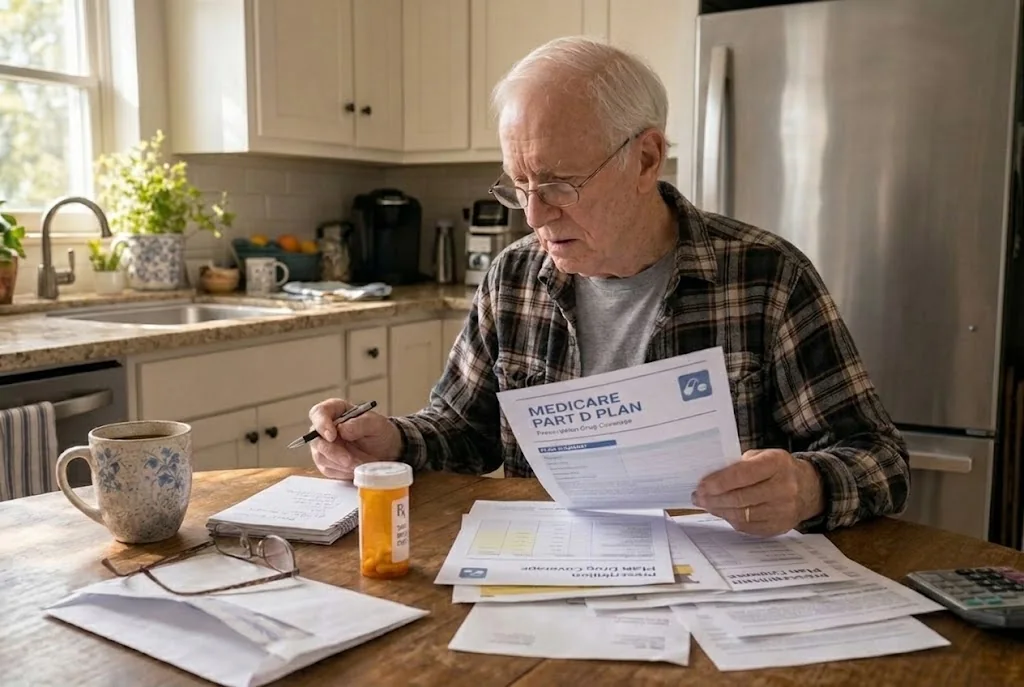

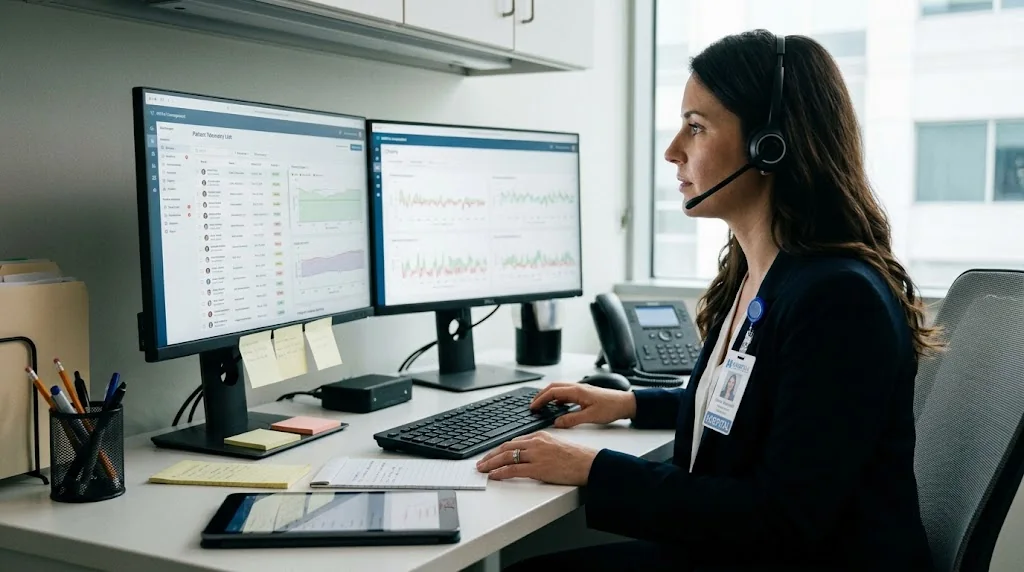
Remote Patient Monitoring (RPM) has expanded across healthcare, creating new opportunities for primary care and specialty practices, physician groups, health systems, and other healthcare organizations to extend care beyond the traditional office visit.
Every day, these programs capture large volumes of physiological data across conditions like hypertension, Type 2 diabetes, heart failure, and chronic kidney disease.
But collecting the data alone doesn’t always result in improved patient care.
Practices can end up with pages of blood pressure readings, glucose values, and daily weights sitting in the Electronic Health Record (EHR), while the clinical and financial outcomes they are trying to improve barely move.
That creates a fundamental problem:
A blood pressure monitor can tell you that a patient’s numbers have been high for three weeks.
It cannot, by itself, fix the underlying issue causing the problem.
Without a defined process to review the readings, determine the appropriate response, and follow through, detecting a problem does not guarantee action.
3 RPM Bottlenecks Healthcare Leaders Must Address
For healthcare leaders responsible for clinical care, operations, and organizational performance, unmanaged RPM data can create three distinct operational bottlenecks:
1. The Clinical Gap: Therapeutic Inertia Across Chronic Conditions
Consider a patient managing hypertension, Type 2 diabetes, and heart failure.
As their condition changes, their medication needs may change too.
Their blood pressure may rise, blood glucose may remain elevated, or weight changes may signal fluid retention.
Yet routine primary care appointments may be weeks or months apart.
RPM gives the care team more frequent information about the patient’s condition.
But a reading alone cannot explain what is causing the change or what needs to be adjusted.
Could the patient be missing doses?
Have they run out of medication?
Are they experiencing side effects, struggling with a complex regimen, or taking a medication that needs to be reviewed?
Without a defined process to investigate these questions, coordinate with the prescribing clinician, and follow through on the appropriate response, important medication-related problems may go unaddressed.
2. Operational Strain: Inbox Alert Fatigue
There is another bottleneck:
Someone has to make sense of all that data.
Flooding primary care inboxes with raw biometric readings can force physicians to spend valuable clinical time sorting through routine data to identify the readings that actually require their attention.
It’s like asking a physician to sort through every piece of mail that arrives just to find the few letters that need an immediate response.
As more readings come in, identifying what matters becomes harder, especially when every alert is routed to the same person, regardless of its clinical significance.
The result can be more administrative work, greater demands on clinicians’ time, and a higher risk of important alerts getting lost among routine notifications.
That’s where a structured clinical review process can help:
Reviewing readings in context, identifying issues that warrant attention, and escalating relevant concerns to the appropriate clinician with the information needed to act.
3. Financial Risk: Program Overhead Without Downstream Savings
RPM also has a financial side.
Devices, connectivity, software, and clinical oversight all require investment.
But that investment only creates an opportunity to improve care; it does not guarantee better outcomes or lower healthcare costs.
If patient readings are collected but not consistently reviewed, acted upon, and followed through, a practice may continue paying to monitor patients without fully addressing the problems those readings reveal.
Over time, that can mean missed opportunities to improve disease control, address medication-related problems, and potentially prevent avoidable emergency visits or costly complications.
The dashboard can be busy while the patients’ conditions remain poorly controlled, and the practice continues to carry the cost.
Medication Management in RPM: Turning Patient Readings Into Better Care
Medication Therapy Management (MTM) helps connect RPM data to the clinical decisions and follow-up that improves patient care.
Rather than allowing patient readings to sit in an EHR, medication management provides a structured way to investigate changes, identify medication-related problems, and coordinate appropriate next steps.
In some settings, under a Collaborative Practice Agreement (CPA) between a prescriber and a clinical pharmacist,
medication management may include activities authorized by applicable law and the agreement.
For example, when a patient’s blood pressure remains elevated, a clinical pharmacist can assess potential medication-related factors, such as missed doses, side effects, access barriers, or recent changes to the regimen.
When further intervention is needed, the pharmacist works with the prescribing clinician to determine the appropriate response.
The physician provides medical oversight and establishes the treatment goals and parameters of collaboration, while the pharmacist contributes specialized medication expertise, patient follow-up, and medication-related assessment within their authorized scope of practice.
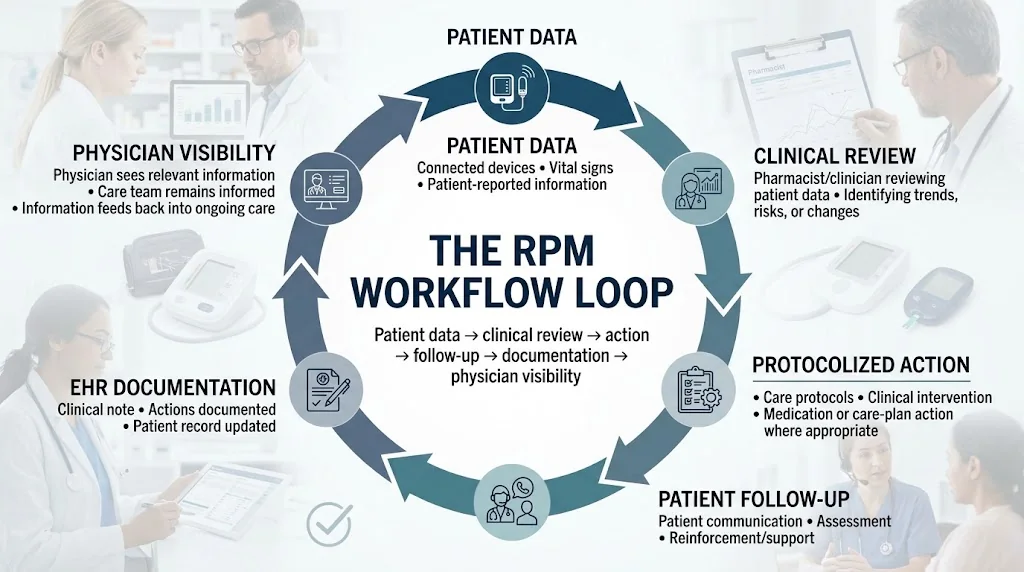
The workflow looks like this:
1. Automated Biometric Transmission
Patients record and transmit physiological data such as blood pressure readings, blood glucose logs, or daily weight measurements, through connected monitors and cellular hubs.
The information now has a path into the clinical workflow.
2. Algorithmic Threshold Evaluation
Readings are evaluated against protocolized targets established by the primary physician, such as individualized blood pressure targets, fasting glucose ranges, or weight change thresholds.
Out-of-range readings may prompt clinical review according to the care team’s protocol.
The important point is that the team is no longer looking only at isolated numbers.
The workflow is looking for a pattern that meets the physician-approved threshold for action.
3. Protocol-Based Medication Adjustment
When the appropriate threshold is reached, the clinical pharmacist operates under the physician’s pre-approved treatment algorithm.
Where permitted by applicable law and an authorized protocol, the pharmacist may adjust medications and order safety-monitoring labs, such as renal function or potassium tests.
The pharmacist operates within the pathway the physician approved.
4. Targeted Patient Coaching and Follow-Up
Clinical pharmacists conduct 15-to-30-minute phone encounters to review lifestyle factors, address barriers to adherence, screen for adverse effects, and resolve post-discharge medication discrepancies.
This is where a number on a screen becomes a conversation with the person behind the number.
5. Closed-Loop EHR Documentation and Communication
Medication assessments, authorized interventions, patient encounters, and follow-up plans are documented in the practice’s EHR, with relevant information communicated to the treating clinician.
This creates a clearer record of what was identified, what action was taken, and what still requires follow-up, helping keep the care team connected.
The Evidence: Impact of Medication Management in RPM
Research and real-world health-system implementations show how combining remote patient monitoring (RPM) with pharmacist-led medication management can support better clinical care and more coordinated follow-up.
While hypertension provides some of the strongest long-term randomized trial evidence, other
real-world implementations demonstrates the model’s value in three areas:
Scalability, Clinical durability, and Economic value.
1. Multi-Condition Scalability: The inSight Health System Program
In an observational evaluation of the inSight Community Outreach Program across 19 primary care practices from March through October 2020, remote monitoring and pharmacist-supported care management served high-risk patients across diabetes, heart failure, CAD, hypertension, COPD, and asthma (Stulock et al., 2022):
- Clinical Escalation Volume: Clinical pharmacists addressed over 1,600 clinical escalations and medication inquiries during the evaluation period, with post-discharge medication reconciliation representing a primary driver of outreach.
- Observational Utilization Comparison: Among high-risk chronic disease management enrollees reached at least once during the March–October 2020 window, observational program data showed a 35% lower rate of all-cause inpatient admissions compared with an age- and risk-matched cohort, though the non-randomized design does not isolate causal impact to pharmacist outreach alone.
The program illustrates how pharmacist involvement can extend beyond a single condition, helping care teams respond to medication questions, worsening symptoms, and emerging care needs across a large primary care network.
2. Clinical Durability Proving Ground: The HyperLink Trial
The HyperLink cluster-randomized clinical trial studied 450 adults with uncontrolled hypertension across 16 primary care clinics, comparing 12 months of home blood pressure telemonitoring plus pharmacist case management against usual care (Margolis et al., 2013):
- Sustained Blood Pressure Control: 57.2% of patients in the telemonitoring and pharmacist-management group achieved blood pressure control at both 6 and 12 months, compared with 30.0% in usual care.
- Systolic BP Reduction: The intervention group achieved a 10.7 mmHg greater reduction in systolic blood pressure from baseline at 6 months and a 9.7 mmHg greater reduction at 12 months compared with usual care.
- Post-Intervention Durability: At 18 months—six months after telemonitoring devices were returned and pharmacist visits ended—blood pressure remained controlled in 71.8% of intervention patients versus 57.1% of usual-care patients, with a 6.6 mmHg greater net systolic BP reduction over usual care.
These findings show what can happen when RPM readings are connected to clinical assessment, pharmacist-led medication management, and follow-up—even six months after the active intervention ended.
3. Long-Term Economic Dominance: Health Economics Modeling
Clinical improvements may also have economic implications.
Two analyses examined the potential financial value of combining home blood pressure telemonitoring with pharmacist case management.:
- Modeled lifetime savings: Padwal et al. (2019; published online in 2018) used a health-economic model for Canadian patients with a recent nondisabling cerebrovascular event.
Over a modeled lifetime, the intervention was projected to generate CAD $1,929 in net healthcare savings per patient while adding approximately 0.83 quality-adjusted life-years (QALYs) compared with usual care.
- Five-year cardiovascular event costs: In a five-year follow-up of the HyperLink trial, Margolis et al. (2020) observed fewer patients experiencing the primary composite cardiovascular outcome in the intervention group than in usual care:
4.4% versus 8.6%.
However, this difference was not statistically significant (P = .09).
- Estimated return on investment: When coronary revascularization was included in a secondary composite outcome, the researchers estimated a 119% return on investment over five years, with approximately US $1,792 in net savings per patient using the study’s discounted cost estimates.
These economic findings are promising, but they require context.
The Canadian savings estimate came from a model rather than directly observed lifetime savings, while the HyperLink economic analysis estimated costs associated with cardiovascular events.
Neither result guarantees that every RPM program will produce the same financial return.
For an analysis of how telehealth care management integrates with broader value-based contracts, read PharmD Live’s Guide to Chronic Care Management & Value-Based Care.
What Healthcare Leaders Should Consider
The evidence supports the potential of combining RPM with pharmacist-led medication management, but outcomes depend on how the program operates.
Three considerations matter:
- Clinical scope: Medication-related concerns must be distinguished from symptoms requiring broader clinical assessment. Clear escalation pathways ensure that concerns outside the pharmacist’s authorized scope reach the appropriate clinician.
- Financial expectations: Better clinical management does not guarantee immediate cost savings. Practices should evaluate program costs alongside clinical outcomes and longer-term economic results.
- Workflow and accountability: Clear protocols, defined responsibilities, timely follow-up, and communication with the treating clinician help connect patient readings to appropriate action.
Diagnosing Your Practice’s RPM Workflow
Practice Managers, MSO Executives, and Clinical Directors can use these four questions to assess how effectively their RPM workflows can improve better care.
- Time-to-Intervention: When an RPM patient has persistently out-of-range blood pressure or blood glucose readings, how long does it take for the pattern to be reviewed, the appropriate clinician to respond, and a medication adjustment to be made when indicated?
- Inbox Friction: Are physicians and clinical staff manually sorting through raw patient readings, or does your workflow identify meaningful trends and route them to the appropriate person for review?
- CPA Scope: If clinical pharmacists are involved in medication management, do the applicable Collaborative Practice Agreements and protocols clearly define their authority to adjust medications, order safety-monitoring labs, and escalate cases requiring prescriber involvement?
- Escalation and Routing: How does your practice filter non-titration escalations (e.g., acute symptoms, general care coordination) to prevent clogging specialized medication management workflows?
Turn RPM Data into Sustainable Clinical Outcomes
Remote patient monitoring can reveal changes in a patient’s condition between visits.
But collecting readings is only part of the work.
Those readings must be reviewed, interpreted, and connected to appropriate clinical action.
By pairing RPM with physician-directed medication management, primary care practices, MSOs, and FQHCs can address medication-related barriers, support timely treatment decisions, and help clinicians maintain better visibility into patients’ changing needs.
Explore PharmD Live’s RPM Program to see how medication management can fit into your RPM workflow.
References
Dehmer, S. P., Maciosek, M. V., Trower, N. K., Asche, S. E., Bergdall, A. R., Nyboer, R. A., O’Connor, P. J., Pawloski, P. A., Sperl-Hillen, J. M., Green, B. B., & Margolis, K. L. (2018). Economic evaluation of the Home Blood Pressure Telemonitoring and Pharmacist Case Management to Control Hypertension (HyperLink) trial. Journal of the American College of Clinical Pharmacy, 1(1), 21–30. https://doi.org/10.1002/jac5.1001
Margolis, K. L., Asche, S. E., Bergdall, A. R., Dehmer, S. P., Groen, S. E., Kadrmas, H. M., Kerby, T. J., Klotzle, K. J., Maciosek, M. V., Michels, R. D., O’Connor, P. J., Pritchard, R. A., Sekenski, J. L., Sperl-Hillen, J. M., & Trower, N. K. (2013). Effect of home blood pressure telemonitoring and pharmacist management on blood pressure control: A cluster randomized clinical trial. JAMA, 310(1), 46–56. https://doi.org/10.1001/jama.2013.6549
Margolis, K. L., Dehmer, S. P., Sperl-Hillen, J., O’Connor, P. J., Asche, S. E., Bergdall, A. R., Green, B. B., Nyboer, R. A., Pawloski, P. A., Trower, N. K., & Maciosek, M. V. (2020). Cardiovascular events and costs with home blood pressure telemonitoring and pharmacist management for uncontrolled hypertension. Hypertension, 76(4), 1097–1103. https://doi.org/10.1161/HYPERTENSIONAHA.120.15492
Padwal, R. S., So, H., Wood, P. W., McAlister, F. A., Siddiqui, M., Norris, C. M., Jeerakathil, T., Stone, J., Valaire, S., Mann, B., Boulanger, P., & Klarenbach, S. W. (2018). Cost-effectiveness of home blood pressure telemonitoring and case management in the secondary prevention of cerebrovascular disease in Canada. The Journal of Clinical Hypertension, 21(2), 159–168. https://doi.org/10.1111/jch.13459
Shi, H., Stark, A., Maity, A., Shah, A., Manganelli, J., Baichoo, P., Korchevsky, S., Suthar, P., Zhang, C., & Rikin, S. (2025). Assessment of clinical pharmacist outreach and medication titration in remote patient monitoring program for hypertension. Journal of Human Hypertension, 39(6), 422–424. https://doi.org/10.1038/s41371-025-01025-5
Stulock, R., Montgomery, J., Parker, M., Soric, A., & Zeleznikar, E. (2022). Pharmacist involvement in a comprehensive remote monitoring and telemanagement program. American Journal of Health-System Pharmacy, 79(11), 888–895. https://doi.org/10.1093/ajhp/zxac025